Navigating the VUCA Storm: Leadership Competencies for a Disrupted World
In an era defined by volatility, uncertainty, complexity, and ambiguity (VUCA),
In an era defined by volatility, uncertainty, complexity, and ambiguity (VUCA),
Navigating the VUCA Storm: Leadership Competencies for a Disrupted World
Introduction: The New Leadership Landscape
The business environment today is not merely turbulent—it is VUCA: volatile, uncertain, complex, and ambiguous. Since the COVID-19 pandemic, these forces have intensified dramatically. Technological disruptions like generative AI rewrite industry rules overnight. Geopolitical fragmentation reshapes supply chains and market access. Cultural shifts, from remote work to generational value changes, challenge traditional hierarchies. Economic uncertainty—inflation, interest rate swings, regional recessions—keeps even seasoned executives off balance.
In this context, a 2024 qualitative study by Shankar Subramanian Iyer (Westford University College), published in the Journal of Entrepreneurship Education, offers timely insight. Iyer conducted in-depth interviews with 20 global leaders across industries—from tech startups in Southeast Asia to manufacturing conglomerates in Europe—probing which competencies truly distinguish effective leadership in a VUCA world. The study's findings distill into a set of core capabilities: adaptability, continuous learning, cross-cultural competence, inclusive leadership, strategic foresight, and ethical decision-making.
These are not aspirational "nice-to-haves." They are strategic imperatives that determine whether an organization can absorb shocks, seize fleeting opportunities, and maintain competitive advantage over the long term. As the study makes clear, the leaders who thrive in disruption are those who have deliberately cultivated these competencies—and built systems to embed them in their teams.
[IMAGE: Abstract visual of a storm with interlocking gears and a compass, representing the complexity of VUCA forces.]
Competency 1: Adaptability and Continuous Learning as Strategic Anchors
Among all themes that emerged from Iyer's interviews, adaptability was the most frequently cited. Leaders described it as the fundamental currency of survival. "You can have the best five-year plan," one respondent noted, "but if you cannot pivot within a quarter, the plan becomes obsolete before it is printed." Rapid technological advancements—from cloud migration to AI automation—demand that leaders not only accept change but actively seek it.
Yet adaptability alone is insufficient without continuous learning. The study underscores that learning is no longer a personal development checkbox; it is an organizational capability that fuels innovation and agility. Leaders who prioritize upskilling—both their own and their teams'—consistently outperform peers in uncertain times. For example, one interview subject described how her company launched a "learning sabbatical" program, allowing employees to spend two weeks per year acquiring skills outside their current roles. The result: faster internal mobility, higher retention, and the ability to redeploy talent when market shifts required new capabilities.
The deep insight here is that in a VUCA world, the half-life of skills is shrinking. Technical knowledge that was cutting-edge five years ago can be obsolete today. Leaders must therefore build learning ecosystems—structured mentorship, micro-learning platforms, cross-functional project rotations—that allow teams to pivot quickly. When volatility strikes, these ecosystems turn potential disruption into opportunity by enabling rapid reskilling.
Moreover, adaptability in a VUCA context is not about reactive scrambling; it is about cultivating a mindset that treats uncertainty as a source of strategic advantage. The leaders Iyer studied shared a common trait: they reframe problems as experiments. Failure is not punished; it is analyzed for lessons. This psychological safety, paired with continuous learning infrastructure, creates organizations that are resilient rather than brittle.
[IMAGE: A leader studying a holographic display with cascading data streams and a digital book, symbolizing adaptive learning in real time.]
Competency 2: Cross-Cultural Competence and Inclusive Leadership
Globalization is not dead, but it has become more complex. Geopolitical tensions, regional trade blocs, and cultural nationalism demand leaders who can navigate differences—not just tolerate them. Iyer's study identifies cross-cultural competence as essential for managing distributed teams and entering new markets.
One telling finding: leaders who demonstrated high cross-cultural competence were significantly more effective at building trust in hybrid and remote teams spread across time zones. They understood that communication norms vary—directness in one culture can be perceived as aggression in another. They invested time in learning about local business practices, religious holidays, and implicit hierarchies. This was not surface-level politeness; it was a strategic tool for reducing friction and accelerating execution.
Inclusive leadership closely follows cross-cultural competence. The study defines inclusive practices as those that actively seek and value diverse perspectives, create psychological safety for dissenting voices, and ensure that decision-making tables reflect the full spectrum of stakeholders. These are not soft skills; they are hard drivers of performance. Companies with inclusive leadership report higher innovation rates, lower turnover, and better financial outcomes—particularly during periods of disruption.
One powerful example from the interviews: a European multinational facing a product launch crisis in Southeast Asia. The local team had identified a critical regulatory mismatch, but had been hesitant to raise concerns due to hierarchical norms. An inclusive leader—one who had explicitly invited pushback and created anonymous feedback channels—caught the issue early, avoiding a costly compliance failure. The study notes that such "courageous inclusion" is a direct antidote to the groupthink and blind spots that VUCA environments exacerbate.
The deep insight here is that cross-cultural competence and inclusive leadership are not separate competencies; they reinforce each other. A leader who understands cultural nuances is better equipped to create inclusive environments, and an inclusive environment encourages the diverse input that sharpens strategic decisions. In a fragmented world, the ability to bridge differences is not just a moral imperative—it is a competitive weapon.
[IMAGE: A diverse group of professionals in a meeting room with world maps on the walls, engaged in animated discussion around a circular table, with flags representing different countries.]
Competency 3: Strategic Foresight and Ethical Leadership
If adaptability helps leaders react quickly, strategic foresight helps them anticipate—and shape—what comes next. Iyer's study found that the most effective leaders in VUCA conditions do not simply respond to events; they systematically scan the horizon for weak signals: demographic shifts, regulatory trends, technological inflection points, and geopolitical undercurrents.
Strategic foresight is not about predicting the future with certainty—an impossible task in an ambiguous world. Rather, it is about developing multiple plausible scenarios and stress-testing strategies against them. One leader interviewed described a "war-gaming" process her organization runs quarterly: a team plays the role of a disruptive competitor, a regulator, or a natural disaster, while the leadership team must react in real time. This builds the mental muscle for rapid decision-making when real crises hit.
But strategic foresight without ethical leadership is dangerous. The VUCA environment creates immense pressure to cut corners: launch a product before safety checks, exploit regulatory gray zones, or prioritize short-term profits over stakeholder well-being. Iyer's study reveals that leaders who sustained high performance over the long term consistently anchored their decisions in a clear ethical framework. They communicated values explicitly, held themselves accountable, and—critically—refused to sacrifice integrity for expediency.
The pandemic served as a stress test for ethical leadership. Leaders who maintained transparent communication about layoffs, paid suppliers early even when cash was tight, and prioritized employee mental health built deep reservoirs of trust that paid dividends in engagement and loyalty. Those who behaved opportunistically saw rapid erosion of culture and reputation.
The deep insight from the study is that strategic foresight and ethical leadership form a virtuous cycle. When leaders have a clear ethical compass, they are more willing to make bold, long-term bets—because they trust that their decisions will stand up to scrutiny. And when they practice strategic foresight, they can anticipate the ethical dilemmas ahead, preparing responses before crises force rushed decisions. Together, these competencies enable leaders to navigate ambiguity without losing their moral bearings.
[IMAGE: A leader looking through a telescope at a complex horizon with multiple branching pathways, while holding a compass in one hand and a small book marked "values" in the other.]
Conclusion: Building the Leadership System for a VUCA World
Iyer's 2024 study offers a clear message: the era of the heroic, top-down leader is over. In a disrupted world, leadership is a distributed capability that must be embedded across teams, functions, and geographies. The competencies explored—adaptability, continuous learning, cross-cultural competence, inclusive leadership, strategic foresight, and ethical decision-making—are not a checklist for individual development. They are the building blocks of an organizational system that can absorb shocks and turn volatility into advantage.
The post-COVID leadership landscape demands that executives invest deliberately in these areas. That means rethinking performance metrics to reward learning and collaboration, not just quarterly results. It means redesigning talent processes to identify and cultivate cross-cultural competence. It means institutionalizing foresight practices, from scenario planning to horizon scanning, as a routine part of strategy. And it means modeling ethical behavior consistently, because in a transparent, interconnected world, every inconsistency is magnified.
For aspiring leaders, the implication is equally clear: the path to future-proofing your career is not about accumulating technical expertise alone. It is about developing the meta-competencies that allow you to thrive in ambiguity—to learn, unlearn, and relearn; to bridge differences; to see around corners; and to lead with integrity when the easy path looks tempting.
The VUCA storm is not passing. It is becoming the new normal. The leaders who navigate it successfully will be those who do not just weather the turbulence, but who learn to harness its energy—turning disruption into direction.
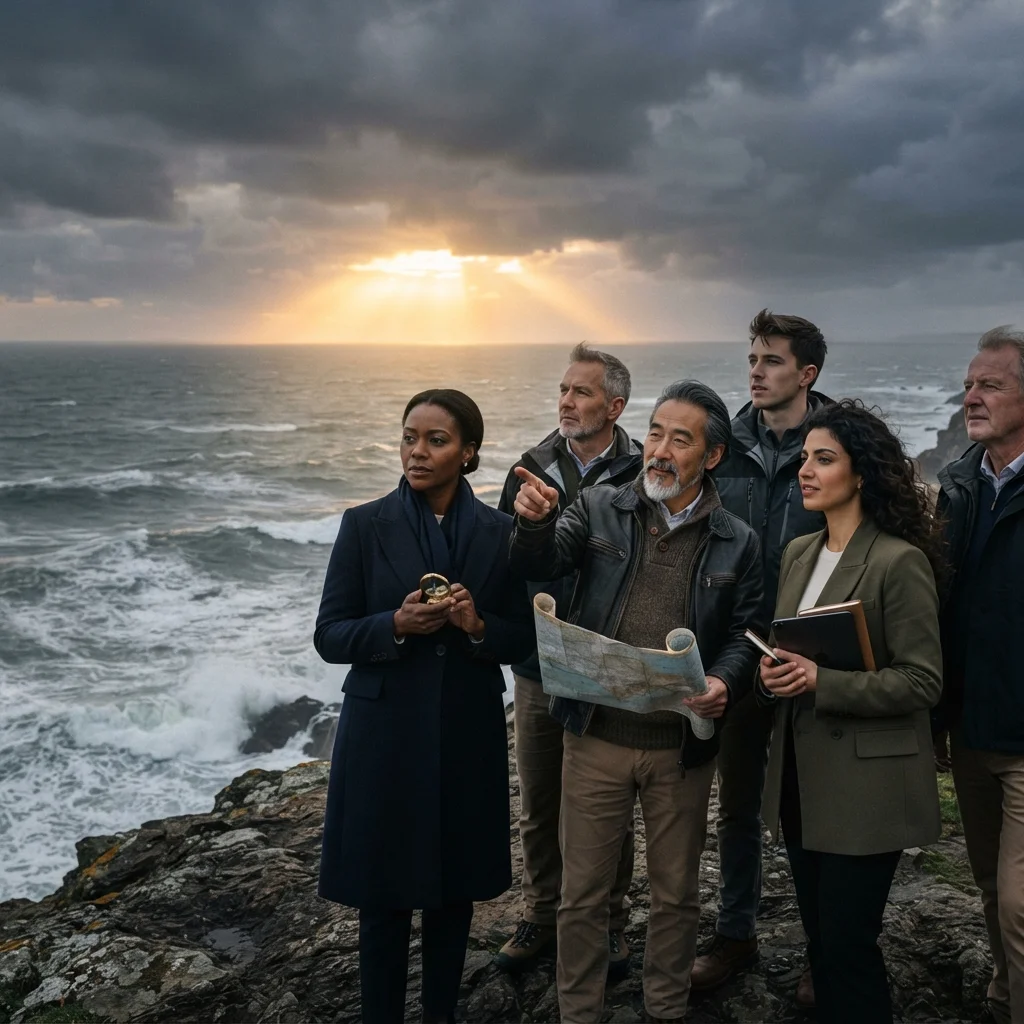
[IMAGE: A diverse group of leaders standing on a rocky cliff overlooking a turbulent sea with storm clouds and lightning, but a clear path of light ahead. They are looking forward, some holding compasses or maps. No text, no watermark. Modern, professional style with a sense of urgency and hope.]
---
Keywords: VUCA leadership, global leadership competencies, adaptability, cross-cultural competence, ethical leadership, strategic foresight, continuous learning, inclusive leadership, post-COVID leadership, leadership challenges
David Chen
Conducts in-depth interviews with European business leaders and policymakers.