Europe''s New FDI Playbook: How Geopolitical Risk is Reshaping Investment
Geopolitical tensions are fundamentally altering global foreign direct investment
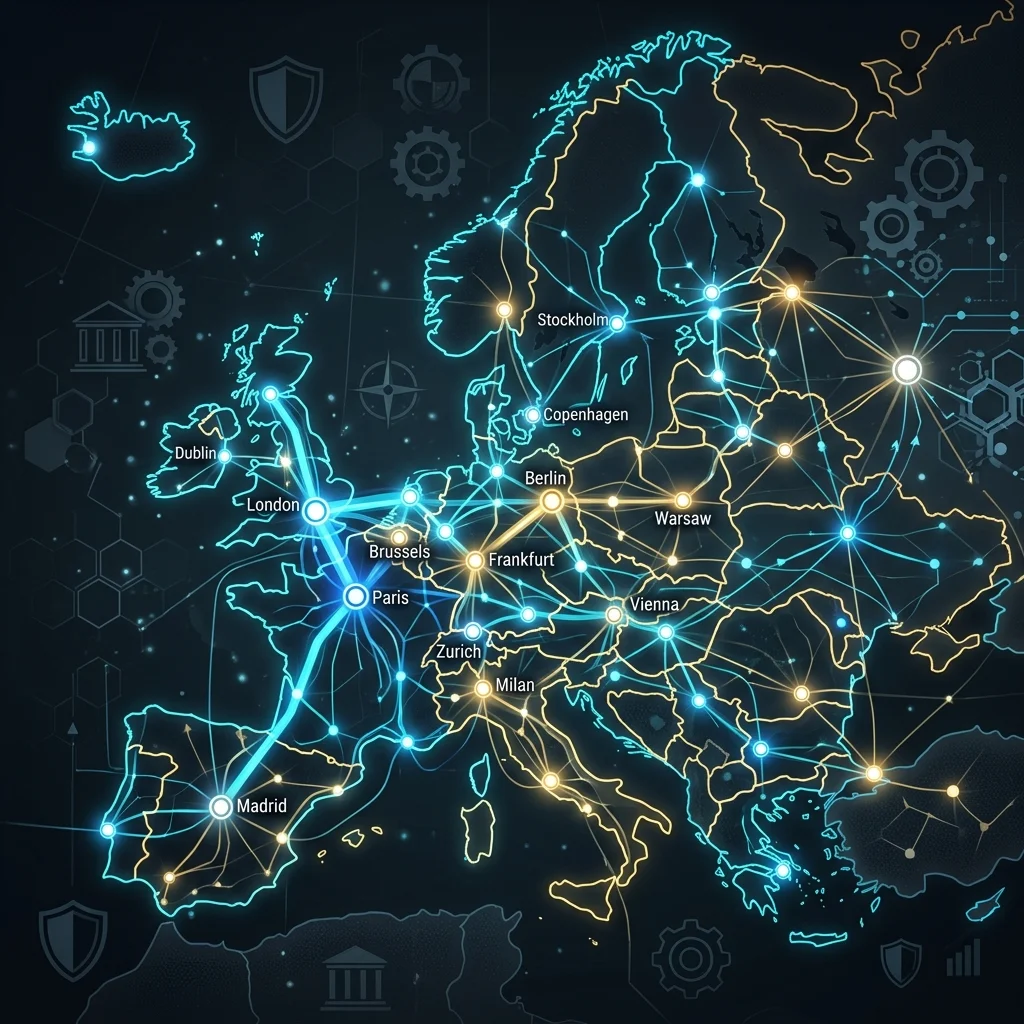
Geopolitical tensions are fundamentally altering global foreign direct investment
Europe's New FDI Playbook: How Geopolitical Risk is Reshaping Investment Decisions and Supply Chains
For decades, foreign direct investment (FDI) flowed along a simple logic: find the lowest-cost location, secure market access, and scale up. That calculus is now obsolete. Geopolitical tensions—from US-China rivalry to the war in Ukraine and Middle East instability—have fundamentally rewritten the rules. Today, corporate leaders evaluating a new factory, R&D center, or logistics hub must weigh political stability, regulatory predictability, and supply chain security alongside traditional cost considerations. Europe, with its dense regulatory framework, ambitious green incentives, and concentration of strategic industries, finds itself both a prime beneficiary and a contested battleground for this new generation of investment.
This article examines how companies are recalibrating their FDI strategies through scenario planning, friendshoring, and diversification. Drawing on insights from EY’s Geostrategic Business Group, it explores the sectors leading the shift—defense, semiconductors, pharmaceuticals, logistics, and energy—and what Europe’s own industrial policies, such as the Net-Zero Industry Act and Critical Raw Materials Act, mean for corporate decision-makers.
[IMAGE: A modern, abstract visualization of a map of Europe with glowing nodes and connecting lines representing investment flows, surrounded by subtle geopolitical symbols like shields and gears, in a clean, professional style suitable for a business analysis article, no text, no watermark.]
---
The New Rules of Location: From Cost to Resilience
Traditional FDI drivers—low labor costs, large consumer markets, tax incentives—are being eclipsed by a more complex factor: geopolitical risk assessment. Companies now rank political stability, regulatory predictability, and operational security above pure cost efficiency. A 2024 survey by EY found that 72% of senior executives consider geopolitical risk a top-three factor in cross-border investment decisions, up from 38% five years ago.
“The era of single-minded cost optimization is over,” says a senior advisor at EY’s Geostrategic Business Group. “Businesses are now running scenario analyses that map out everything from trade sanctions to export controls, from energy price volatility to military conflict. That changes where they put their capital.”
One key tool is stress-testing supply chains against geopolitical shocks. A European automotive supplier, for example, might model what happens if a key semiconductor fab in Taiwan is disrupted, then adjust its FDI to invest in a backup facility in Germany or Poland. Another is the inclusion of “resilience premiums” in project valuations—accepting higher upfront costs if the location offers lower long-term geopolitical risk.
[IMAGE: Bar chart showing decline of cost as primary factor vs resilience factors (political stability, regulatory predictability, operational security) in FDI decisions, with percentages from a 2024 survey.]
This shift is visible in the data. According to fDi Markets, greenfield FDI projects in Europe that explicitly cite “supply chain resilience” in their rationale more than doubled between 2020 and 2024. Meanwhile, investment in countries perceived as geopolitically risky—such as those near conflict zones or under heavy sanctions regimes—has declined sharply.
The implications for Europe are significant. The region’s relatively stable political environment, robust legal systems, and deep integration into global standards make it an attractive anchor. Yet intra-European competition is intensifying: member states are racing to offer incentives, streamlined permitting, and infrastructure for high-priority projects, particularly in critical technologies.
---
Sector Spotlight: Where Friendshoring is Winning
Not all industries are moving at the same speed. Five sectors are leading the nearshoring and friendshoring wave, each driven by distinct geopolitical pressures.
Defense: Europe’s defense industry is undergoing a historic ramp-up. The war in Ukraine exposed critical gaps in ammunition production, armored vehicles, and drone manufacturing. NATO’s new target of 2.5% GDP defense spending and the EU’s European Defence Industrial Strategy are channeling FDI into new plants across Central and Eastern Europe. Romania, Poland, and the Baltics are seeing a surge in foreign defense contractors setting up production lines, encouraged by host government co-financing and regulatory fast-tracking.
Semiconductors: The EU Chips Act, with its €43 billion in public and private investment, is creating a magnet for semiconductor FDI. TSMC’s planned fab in Dresden, Intel’s massive investment in Magdeburg, and STMicroelectronics’ expansion in France all reflect a strategic push to reduce reliance on Asian foundries. These projects are not about low cost; they are about securing access to advanced nodes for automotive, industrial, and defense applications. The European Commission has also introduced “friendshoring” criteria, favoring investments from trusted allies.
[IMAGE: Map of Europe with icons for defense (tank/chip/syringe/truck/oil rig) highlighted in different colors across key locations like Poland, Germany, France, Spain, and the Netherlands.]
Pharmaceuticals: The COVID-19 pandemic revealed the vulnerability of relying on India and China for active pharmaceutical ingredients (APIs) and generic medicines. Europe is now reshoring production of critical medicines, supported by the EU’s Critical Medicines Act and national programs. France’s “Plan Biotech” and Germany’s “Pharma-Strategie” offer subsidies for new API plants and sterile manufacturing. Spain and Portugal are also attracting investment in biologics and vaccine production, leveraging existing pharma clusters.
Logistics: As trade routes face disruption—from Red Sea Houthi attacks to Panama Canal droughts—logistics firms are regionalizing hubs. Major ports like Rotterdam, Antwerp, and Hamburg are expanding inland warehousing and rail connections. “Nearshoring of logistics is not just about shortening physical distance; it’s about building redundancy,” says a supply chain director at a global 3PL. Investments in automated distribution centers in the EU’s eastern periphery (Czech Republic, Slovakia, Hungary) are rising as companies hedge against chokepoints.
Energy: Energy security has become a foreign direct investment driver in its own right. Europe is diversifying away from Russian gas through LNG terminals, pipeline interconnections, and massive renewables build-out. The Critical Raw Materials Act aims to secure supplies of lithium, cobalt, and rare earths needed for batteries and wind turbines. FDI is flowing into mining projects in Portugal and Sweden, refining capacity in Germany, and recycling plants across the continent.
---
The Selective Investor: Resilience Over Volume
One consequence of the new geopolitical calculus is that businesses are becoming far more selective about where and what they invest in. Rather than chasing the highest returns, they prioritize projects that shorten supply chains, secure access to critical technologies, and align with strict environmental and governance standards.
EY’s Geostrategic Business Group describes this as a “funnel effect”: companies evaluate many potential FDI projects but approve only a few that meet stringent resilience criteria. A typical screening now includes geopolitical risk scoring, dependency analysis, regulatory alignment with home-country policies, and a “friendship audit” of the host nation’s alliances. Projects that pass are often smaller in capital expenditure but higher in strategic value.
This selectivity may reduce total FDI volume into Europe in the short term. The UNCTAD World Investment Report 2024 noted that FDI inflows to Europe fell 12% in 2023, partly due to macroeconomic headwinds but also because investors are waiting for geopolitical clarity. However, the quality of investment is improving: deals are more aligned with Europe’s digital and green transitions, and they tend to create higher-skilled jobs.
[IMAGE: Infographic showing a funnel: many FDI projects considered (with icons like factories, labs, hubs) filtered through 'geopolitical risk' and 'resilience criteria' gateways, with only a few selected that are labeled 'high strategic value'.]
For European policymakers, this selectivity intensifies competition. Member states are vying for the same pool of high-value projects—chip fabs, battery gigafactories, hydrogen plants, pharmaceutical facilities. The Netherlands, for example, recently launched a €1.5 billion “Strategic Investment Fund” to co-finance projects in semiconductors and biotech. Germany’s federal government has cut red tape for strategic projects, and France is using its “France 2030” plan to fast-track permits.
Smaller EU nations, such as Ireland, Portugal, and the Baltic states, are positioning themselves as reliable, flexible alternatives to larger economies, offering lower costs and skilled workforces without the geopolitical baggage of non-EU locations.
---
Mitigation Playbook: Diversification, Regionalization, and Securing Strategic Materials
Companies are not simply reacting to geopolitical risk; they are actively building resilience through three core strategies: diversification of suppliers, regionalization of production, and securing access to strategic raw materials.
Diversification means moving away from single-source dependencies, particularly on China for rare earths, on Taiwan for advanced chips, and on Southeast Asia for electronics assembly. European automakers, for instance, are now signing long-term contracts with lithium producers in Australia, Chile, and Africa, while simultaneously investing in European refining. The EU’s Critical Raw Materials Act sets targets: by 2030, no more than 65% of the EU’s annual consumption of any strategic raw material should come from a single third country.
Regionalization involves building production hubs closer to end markets. This is not a full-scale reshoring; rather, it is a “regionalization of value chains” where final assembly and key component manufacturing are located within the same macro-region. In Europe, this is driving FDI into Central and Eastern Europe: Poland, Czechia, and Romania are attracting automotive battery plants, electronics factories, and machinery manufacturing, partly because they offer proximity to Western European consumers and a stable geopolitical environment.
Securing strategic materials has become a national security priority. Europe’s Critical Raw Materials Act also includes measures to streamline permitting for mining and processing projects, create a “critical raw materials club” with like-minded partners, and stockpile reserves. Corporate investors are responding by forming joint ventures with mining companies and setting up captive recycling operations. For example, Northvolt’s battery recycling plant in Sweden and Umicore’s cathode materials facility in Poland are direct results of this push.
[IMAGE: Diagram showing supply chain nodes with arrows indicating diversification (multiple supplier countries) and regional hubs in Europe (e.g., battery gigafactories in Poland, semiconductor fabs in Germany, pharma plants in France).]
Digitalization and automation are enabling these strategies without crippling cost penalties. Advanced robotics, additive manufacturing, and AI-driven supply chain software allow factories in higher-cost European locations to achieve productivity levels that rival lower-cost Asian sites. “The cost gap is narrowing,” says a manufacturing director at a major electronics firm. “When you factor in shipping delays, tariff risks, and the hidden costs of inventory buffers, a European plant can be more competitive than it looks on paper.”
Yet challenges remain. Europe’s energy costs, particularly after the gas crisis, are still higher than in many competitor regions. Labor shortages, especially in engineering and skilled trades, are a persistent bottleneck. And regulatory fragmentation—different national rules on state aid, permits, and environmental impact assessments—can slow projects.
---
Implications for Corporate Strategy: Europe as a Stabilizer
For global corporations navigating an era of geopolitical turbulence, Europe offers something rare: regulatory predictability. The EU’s comprehensive legal frameworks—such as the Carbon Border Adjustment Mechanism (CBAM), the Sustainable Finance Disclosure Regulation, and the EU Taxonomy—provide a stable, long-term rulebook for investment. While companies may complain about the administrative burden, they increasingly value knowing exactly what rules will apply for the next decade.
“In a world where trade policies can change overnight and tariff lines are weaponized, Europe’s regulatory consistency is an asset,” notes a director at EY’s Geostrategic Business Group. “It allows businesses to make ten-year investment plans with confidence.”
This is particularly true for greenfield FDI in sectors that require long lead times: semiconductor fabs (3–5 years to build), battery gigafactories (2–4 years), and pharmaceutical plants (3–5 years). Investors in these industries report that Europe’s clear regulatory pathways—despite some delays in permitting—are less risky than the opaque, politically driven environments of other regions.
However, Europe is not a passive beneficiary. Its own industrial policies are actively shaping investment flows. The Net-Zero Industry Act, which sets targets for domestic manufacturing of clean tech, is creating a pull for FDI in solar panels, wind turbines, electrolyzers, and heat pumps. The European Sovereignty Fund, once fully operational, will provide additional public capital for strategic projects. And the EU’s trade defense instruments—such as anti-subsidy investigations into Chinese electric vehicles—are designed to protect domestic industries while encouraging foreign companies to set up production inside the EU.
[IMAGE: A simple infographic showing a balance scale: on one side 'Geopolitical Risks' (with icons like sanctions, cyber threats, trade wars), on the other side 'Europe's Stability Factors' (regulatory predictability, green incentives, skilled workforce, legal certainty). The scale tips toward Europe.]
For corporate strategists, the implications are clear. Europe should be seen not merely as a market but as a stabilizer in an otherwise volatile global system. Investments in Europe offer a hedge against disruptions in Asia, a gateway to the world’s largest single market, and a platform for influencing global standards. The companies that succeed in the next decade will be those that embed geopolitical resilience into their FDI playbook—and Europe, with all its complexities, is the natural starting point.
Yet a word of caution: Europe’s attractiveness is not guaranteed. The continent faces its own risks: political fragmentation (a resurgent far-right in some countries), demographic decline, and energy competitiveness. To maintain its position as a top FDI destination, Europe must continue to streamline permitting, invest in digital and physical infrastructure, and deepen its internal market. The prize is enormous: selective, high-quality FDI that strengthens its industrial base, secures critical technologies, and builds a resilient supply chain for the future.
In the end, the new FDI playbook is not about volume—it is about strategy. And for that, Europe is writing the rules.
---
This article is based on analysis from EY’s Geostrategic Business Group, corporate case studies, and European Commission policy documents. All data is sourced from publicly available reports as of early 2025.
James Morrison
James has covered European business for over 15 years, specializing in corporate strategy and cross-border M&A.